Norwegian Wood
Norwegian WoodNorwegian Wood is the Beatles song that gives Haruki Murakami’s novel its title and one of its most concentrated devices for linking music with memory. A recording heard at Hamburg Airport returns Toru Watanabe to the meadow of his youth; later, Naoko describes the song as a lonely, dark landscape and asks to hear it under a rule that makes each request deliberate. Its appearances bind different moments together without making grief disappear: the music recalls the dead, but cannot restore them or make loss manageable.
The song as a frame for memory
At thirty-seven, Toru is on a 747 approaching Hamburg Airport in cold November rain when a soft orchestral cover of Norwegian Wood plays through the cabin speakers. The melody sends a shudder through him, and its effect is stronger than before. He bends forward, then looks out at the clouds and thinks of what he has lost: vanished times, dead or missing friends, and feelings he will never experience again. As passengers prepare to leave the aircraft, his attention moves instead to the meadow of autumn 1969, when he was nearly twenty. The song thus makes the novel’s movement between adult recollection and youthful experience audible: the present scene opens onto the remembered past rather than simply introducing it.
The recording’s power is not explained away as a neutral association. At the airport, the tune brings a physical and emotional disturbance that Toru struggles to contain, even as he tells a stewardess that he is merely dizzy. He later identifies the force of the episode as a reason for writing: the blows of memory have become longer and harder, and writing things down is how he tries to understand. The song is therefore connected not only to what he remembers but to the act of telling the story. Music triggers the return; narration is his effort to give that return a form.
Naoko’s request and the song’s private meaning
At the sanatorium, Norwegian Wood has a distinct place in Naoko’s relationship with music. When she asks Reiko to play it, she puts a hundred-yen coin into a porcelain beckoning-cat bank. The payment is a rule: because it is her favourite, she pays whenever she deliberately requests it. Reiko jokes that the arrangement supplies her cigarette money, but the ritual also marks a difference between hearing the song by chance and choosing to hear it. Reiko does not play it unless Naoko asks.
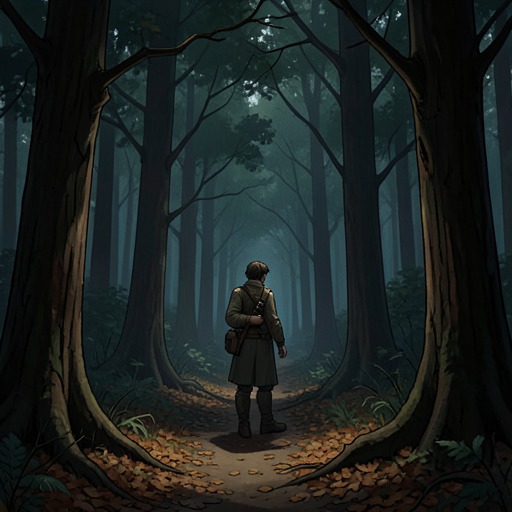
Naoko explains the song through an imagined landscape of isolation. It makes her picture herself wandering alone in a deep wood, where it is cold and dark and nobody comes to save her. Her response gives the title’s woodland image an intimate emotional meaning without establishing that the imagined place is real. The song can be a favourite and a source of sadness at once; the small payment ritual acknowledges that its effect is something Naoko approaches by choice, not something she treats lightly.
The scene also sets Naoko’s response beside Reiko’s performance. Reiko plays with feeling but does not let the music become sentimental. After the song, she turns to other music while Toru watches Naoko, whose appearance seems changed after half a year: he notices a calmer quality alongside the features he recognizes. The music is part of an encounter shaped by change and remembrance, not a simple return to an unchanged past.
Repetition, loss, and the limits of understanding
The song’s appearances echo the novel’s distinction between remembering and recovering. Toru’s writing is an attempt to understand why the melody has affected him so deeply, but the story does not present understanding as a cure. He had earlier come to see death not as something separate from life but as part of it. That insight helps him frame his experience, yet, after Naoko’s death, he learns that no truth, sincerity, strength, or kindness can cure the sadness of losing someone loved. The song’s recurrence belongs to this tension: it gives grief a recognizable form while leaving grief intact.
After Naoko dies, Toru travels along the coast, as far from Tokyo as he can get, thinking about her and struggling to accept that she is gone. Memories return in surges, carrying him into an inward place where he can still imagine speaking with and holding her. In that mental landscape, death is among the elements of life rather than an absolute barrier; when the memories recede, however, he is left alone with sorrow. Against this pattern, Norwegian Wood is not a lesson that makes bereavement easier. Its return gives memory a sound, while the painful difference between the remembered person and the person who has died remains.
When Toru eventually returns to Tokyo, he shuts himself away for days, his attention fixed on the dead rather than the living. This withdrawal gives the novel’s music-and-memory pattern a consequence beyond recollection: remembrance can preserve a bond, but it can also keep the bereaved from turning toward the living. The song does not resolve that conflict. Its significance lies partly in returning Toru to what he has lost and partly in making audible how difficult it is to return from that past.
Naoko’s final days and Reiko’s memorial
In Reiko’s account of Naoko’s final days, music accompanies a moment that appears to offer a new beginning. Naoko has burned her diary and the letters she received, including Toru’s, explaining that she wants to get rid of everything from the past so she can be reborn in the future. That evening, Reiko and Naoko share supper, wine, and music by the Beatles, including Norwegian Wood and Michelle, before going to bed. The sequence places the song beside Naoko’s stated wish to leave the past behind, but does not make that wish proof that she has escaped it.
Later, at the private funeral for Naoko, Reiko again plays Norwegian Wood among a selection of Beatles songs. She sings Here Comes the Sun, plays The Fool on the Hill, and sets out seven matches as she counts the songs. She describes the music as knowing something about life’s sadness and gentleness. In this setting, the title song shifts from Naoko’s chosen request to part of a farewell shaped by Reiko and Toru. The melody can be performed again and heard by another person; the life and relationship it recalls cannot be brought back. Its repetitions gather the novel’s memories into a shared act of remembrance without pretending that remembrance ends grief.